

Milia are tiny, pearly-white bumps that show up most often around the eyes and on the cheeks. Here's how to get rid of milia safely: leave them alone first, because many clear up on their own. Keep your routine gentle, with sunscreen and, if your skin tolerates it and you aren't pregnant, a retinoid. If a bump stays for months or bothers you, have a dermatologist remove it with sterile tools. Don't squeeze, scrape, or poke them at home.
Here's the part most guides rush past. A milium is usually temporary: a Cleveland Clinic article on milia says adults can have them for a few weeks to a couple of months before they clear up on their own. A dark mark from digging one out can outlast it. Writing about darker skin tones, the American Academy of Dermatology (AAD) says a dark spot can appear as a wound heals, and that a spot a few shades darker than your natural skin color usually fades within 6 to 12 months once its cause stops. Deeper discoloration can take years. The fastest-looking fix can turn out to be the slowest.
Below: what milia are, what causes them, three steps for getting rid of them, melanin-rich skin, where a facial fits, and when to see a doctor.
What Are Milia?
Milia are tiny white cysts that form when dead skin cells get trapped in small pockets at the skin's surface. They aren't pimples, and they aren't harmful. One bump is called a milium.
MedlinePlus, from the U.S. National Library of Medicine, says milia are almost always seen in newborn babies, but adults may develop them on the face too. It notes that even when the skin around one gets irritated, the middle of the bump stays white, and that milia are not a true form of acne. A Cleveland Clinic article puts it plainly: "Milia don't need treatment because they're not harmful."
The Primary Care Dermatology Society, a UK society for family doctors, says the face is the most common site, especially the eyelids and cheeks. It describes uniform, round bumps about 1 to 2 millimeters across, usually white, sitting just under the surface.
Milia or whitehead? How to tell them apart
The two look alike, but they need different care. MedlinePlus describes whiteheads as small, white, raised bumps that form when oil and skin collect in the pores, and calls them one type of acne. Milia are trapped skin, not clogged pores.
| Milia | Whiteheads | |
|---|---|---|
| What it is | A tiny cyst of trapped dead skin | A pore clogged with oil and skin |
| Is it acne? | No, says MedlinePlus | Yes, one type of acne |
| Where | Mostly eyelids and cheeks | Often the face, chest, and back |
| Next step | Wait, stay gentle, see a dermatologist for removal | An acne routine for clogged pores |
Clogged-pore bumps have their own playbook in our guide to closed comedones. Feeling rough patches or dark raised spots instead? Our textured skin guide sorts the other look-alikes.
What Causes Milia?
Every milium starts the same way: dead skin cells get trapped instead of shedding. What traps them varies:
- Primary milia appear without an obvious trigger. Cleveland Clinic says they're common on the eyelids, forehead, cheeks, or genitals.
- Secondary milia follow skin damage. Cleveland Clinic names burns, rashes, blisters, and sunlight exposure. The Primary Care Dermatology Society adds dermabrasion, blistering conditions, long-term steroid use that thins the skin, and radiotherapy.
- Newborn milia are common. Cleveland Clinic says about half of all healthy infants have milia when they're born.
Do eye creams cause milia?
Rich eye creams take a lot of the blame online. Cleveland Clinic says secondary milia "can also form as a reaction to a heavy skin cream or ointment," which makes a heavy product a fair suspect. But we searched PubMed in November 2026 for studies linking eye creams, moisturizers, or emollients to milia and found no study that tested whether an eye cream causes them. Treat it as a suspect, not a verdict.
Our advice: if milia showed up after you started a rich eye cream, balm, or ointment, switch to a lighter formula around your eyes for a couple of months and watch. Never stop a prescription cream on your own, though. Cleveland Clinic lists long-term steroid creams as another trigger and advises against using steroids longer than prescribed, so ask the doctor who prescribed yours.
Sun exposure and milia in Central Florida
Sunlight is on Cleveland Clinic's list of damage behind secondary milia, and its advice includes avoiding excessive sun and using sunscreen when you go outdoors. The Primary Care Dermatology Society says eruptive milia are most often seen in young women, "perhaps as a sequel to sunbathing." That "perhaps" matters: it's a possible link, not a proven one. In Central Florida, our guide to sunscreen for dark skin helps you choose one you'll wear every day.
How to Get Rid of Milia Without Picking, Step by Step
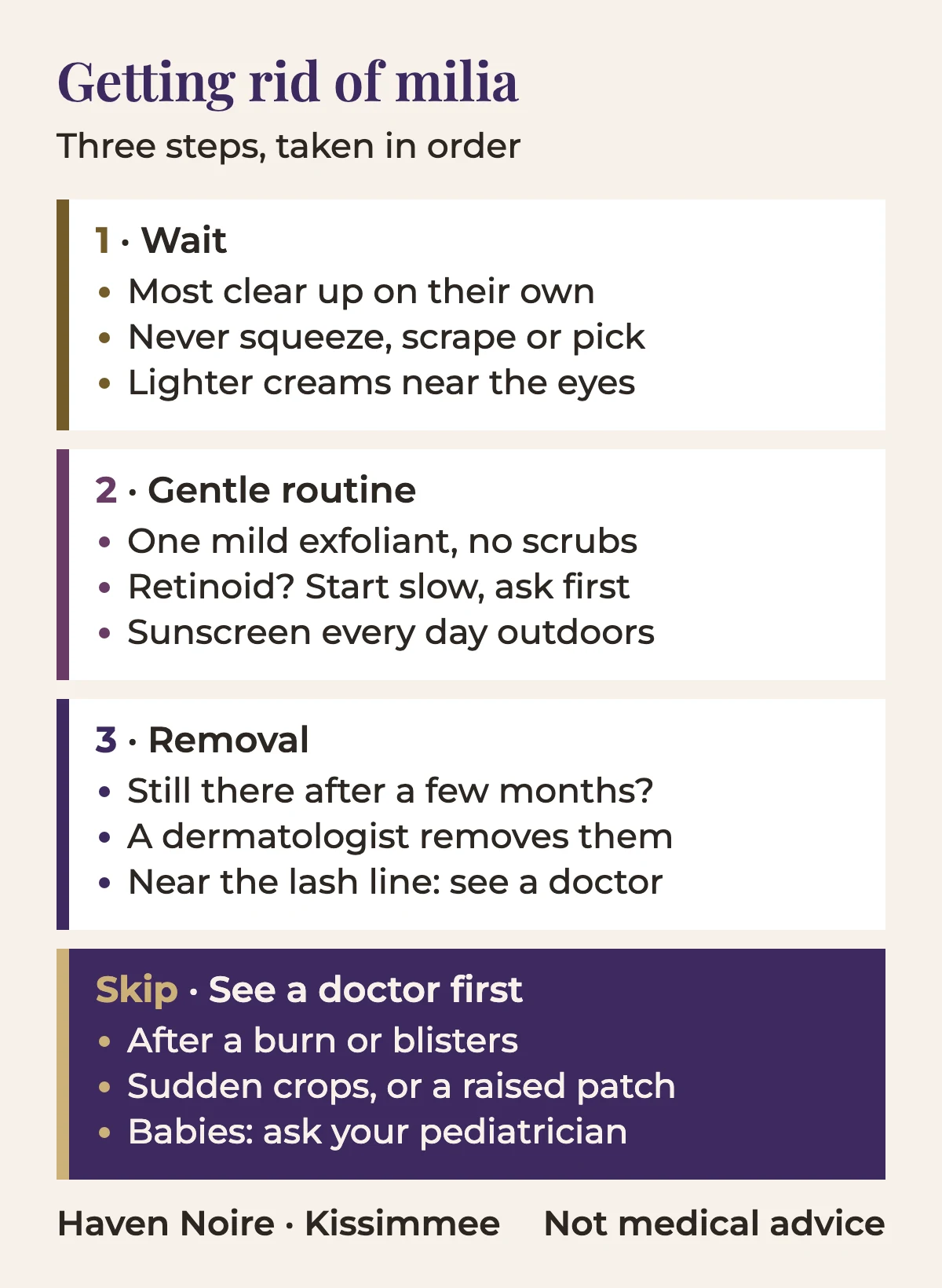
Many guides on how to get rid of milia jump straight to removal. The sources lead with patience, so we've put the options in order, from hands-off to a dermatologist's office. Any timing or tip not credited to a source is our own advice, not a medical rule, and none of this is a diagnosis. Some bumps should skip straight to a doctor; they're listed in the doctor section below.
Step 1: Wait, and take away the trigger
The first step is usually doing less. The Primary Care Dermatology Society says treatment isn't necessary and that milia disappear on their own in the majority of cases. While you wait:
- Keep your hands off. Cleveland Clinic says not to squeeze or scrape off milia on your own, because it can scar your skin or cause an infection.
- Wash gently. Cleveland Clinic suggests warm water and gentle soap every day, then patting your skin dry.
- Lighten up near your eyes if a rich cream or ointment is your suspect. Using coconut oil near your eyes? See why it's a skip if you've had milia.
- Wear sunscreen whenever you go outdoors.
Step 2: Try a gentle routine
If the bumps hang on, the next step is a gentle routine that helps skin shed. Cleveland Clinic says adults might try an over-the-counter exfoliating treatment, and its treatment list starts with over-the-counter adapalene gel or prescription tretinoin cream. That's the source's suggestion, not a promise, and it isn't a reason to scrub harder.
First, check whether this step is for you. The AAD's retinoid page says retinoids should not be used during pregnancy, and that people with a lot of redness or inflammation, such as rosacea, should avoid them and ask a dermatologist about other options. If you take isotretinoin, use tretinoin or another prescription skin medicine, or have eczema, ask your dermatologist before adding any exfoliant or retinoid.
- Pick one exfoliant, not three. The AAD's guide to exfoliating safely at home says people with dry, sensitive, or acne-prone skin may prefer a washcloth and a mild chemical exfoliator, since mechanical exfoliation may be too irritating.
- Go easy on frequency. Our guide to how often you should exfoliate helps you set your number.
- Start a retinoid slowly, if you start one. A dermatologist quoted on the AAD's retinoid page advises the least-intense formula every other night at first, at night only, with sun protection by day. Our guide on how to use retinol walks you through it.
- Don't stack. The AAD warns that exfoliating while you use a retinoid, retinol, or benzoyl peroxide may worsen dry skin or even cause breakouts.
- Give it a few months. Cleveland Clinic advises seeing a provider if milia aren't improving after a few months.
New pimples after starting a retinoid are a different question; our guide to skin purging covers them.
Step 3: Have a dermatologist remove them
If milia stay, spread, or bother you, removal is the last step, and it happens in a doctor's office. MedlinePlus says adults may have milia removed to improve their appearance. Cleveland Clinic describes removal with a needle in a healthcare provider's office, or freezing with cryotherapy. The Primary Care Dermatology Society's guidance, written for family doctors, describes the same kind of office procedure: a clinician breaks the surface with a sterile needle or the point of a blade.
That sounds simple, which is why people try it at home with a pin. Don't: scarring and infection are the risks Cleveland Clinic names. Our advice is that any bump on an eyelid or near the lash line goes to a doctor. Milia removal, cryotherapy, and laser aren't services on our menu.
Our Signature Facial lists "exfoliation and extractions as needed, to refine texture and clear congestion." That's a step for clogged pores, and our guide to facial extractions explains what it does and doesn't do. If a bump looks like milia you want gone, we'll tell you it's a dermatologist visit.
| Step | What you do | What the sources say | Go to the next step when |
|---|---|---|---|
| 1. Wait | Hands off, gentle washing, sunscreen, lighter eye creams | PCDS: most clear up on their own | Bumps last past a couple of months |
| 2. Gentle routine | One mild exfoliant; a slow-start retinoid if it's safe for you | Cleveland Clinic: try an over-the-counter exfoliant. AAD: start retinoids slowly | No improvement after a few months |
| 3. Removal | A dermatologist removes them | Cleveland Clinic: needle extraction or freezing in a provider's office | You want them gone, or they keep coming back |
| Skip | See a doctor first; for a baby, ask your pediatrician | Cleveland Clinic and PCDS: milia after burns or blisters | Start here |
Milia on Melanin-Rich Skin: Why Slow Is Faster
On brown and Black skin, the slow way to get rid of milia is the smart one: gentle beats fast. The AAD's guide to fading dark spots in darker skin tones says dark spots often appear as a wound from a cut, burn, or other injury heals, and when a product irritates your skin. Our reading: a milium dug out with a pin is a small wound, and a scrub that leaves your cheeks raw is irritation.
Then there's the clock. The AAD says a spot a few shades darker than your natural skin color usually fades within 6 to 12 months once its cause stops; Cleveland Clinic says adult milia can clear in a few weeks to a couple of months. That's the speed trap: rushing a temporary bump can buy you a longer-lasting mark.
The AAD's exfoliation guide says to avoid strong chemical or mechanical exfoliation if you have a darker skin tone or get dark spots after burns, bug bites, or acne, because for some people, especially those with darker skin tones, more aggressive exfoliation can lead to dark spots. On retinoids, a dermatologist quoted by the AAD cautions that with skin of color, irritation can trigger dark marks, and that starting slowly with moisturizer helps.
- Choose gentle over fast, and stop any product that stings or peels.
- Wear tinted sunscreen daily. The AAD recommends one with iron oxide, SPF 30 or higher, and broad-spectrum protection.
- Say if you mark easily. Tell your esthetician or dermatologist if breakouts, bug bites, or past treatments have left dark spots.
If a mark has already formed, start with how to fade hyperpigmentation on melanin-rich skin.
Can a Facial Help With Milia? Where We Fit
We're estheticians, not doctors. Tiffany, our founder, is a Florida-licensed esthetician, and we can't diagnose a bump. A facial isn't milia removal and won't replace a dermatologist, but it can add two things: a skin analysis, after which we'll tell you if a bump looks like one for a dermatologist, and home-care advice. After a Signature Facial, your esthetician recommends home-care products for between visits, the right moment to ask about lighter options near your eyes.
| Service | Time | Price | What to know |
|---|---|---|---|
| Signature Facial | 60 minutes | $95, or 3 for $210 | Double cleanse, skin analysis, exfoliation and extractions as needed, then serums, moisturizer, and SPF |
| Signature Facial | 90 minutes | $110, or 3 for $285 | More time, including an added eye treatment; tell us about bumps near your eyes |
| Corrective Facial | 60 minutes | $135, or a 3-pack for $360 | Customized for acne and congestion, uneven tone, or rough texture |
Our Signature Facial is the gentle place to start. If congestion or uneven tone is part of the picture, look at our corrective facials. For home care, ask about the professional skincare lines we work with.
When to See a Dermatologist or Doctor About Milia
Milia are harmless, but some situations call for a doctor before any home routine or facial. See a board-certified dermatologist, or your pediatrician for a baby, when:
- Your baby has milia and you're worried. MedlinePlus says babies need no treatment, and Cleveland Clinic says not to use adult lotions or oils on a baby.
- Milia aren't improving after a few months, are getting worse, or you don't like how they look. Those are Cleveland Clinic's reasons to see a provider.
- Milia appeared after a burn, a blistering rash, or another skin injury. The Primary Care Dermatology Society links them to burns and blistering conditions.
- Many milia appeared in groups over weeks to months. Cleveland Clinic calls this multiple eruptive milia, a rare condition.
- The bumps cluster on a raised patch, often behind the ear or on an eyelid, cheek, or jaw. Cleveland Clinic calls this milia en plaque.
- A bump sits on your eyelid rim or near your lashes (our advice).
- You take isotretinoin and new milia appear. A 2026 case report in Cureus describes one patient who developed eruptive milia on the drug and calls it a rarely reported side effect. Tell the doctor who prescribed it, and don't stop the medicine on your own.
- A bump is growing, bleeding, itching, or changing in any way. The AAD's guide to skin cancer in darker skin tones lists that among the changes to look for.
Pregnant, or taking isotretinoin, tretinoin, or another prescription skin medicine? Ask your doctor or dermatologist before trying the gentle routine above. Living with eczema or rosacea? Ask your dermatologist first; our page on sensitive and redness-prone skin explains how we work alongside your physician's care. Not sure where your bumps fit? Contact us before you book.
Frequently Asked Questions About Milia
What's the fastest way to get rid of milia?
The quickest route is removal in a dermatologist's office, since waiting can take weeks to months. Cleveland Clinic describes a healthcare provider removing milia with a needle in the office, or freezing them with cryotherapy. Don't try it at home: Cleveland Clinic says squeezing or scraping milia yourself can scar your skin or cause an infection.
How long do milia last on adults?
Cleveland Clinic says adults can have milia for a few weeks to a couple of months before they clear up on their own, though some types last longer. The Primary Care Dermatology Society says most disappear without treatment. If yours aren't improving after a few months, Cleveland Clinic advises seeing a healthcare provider.
Does retinol get rid of milia?
Cleveland Clinic lists over-the-counter adapalene gel and prescription tretinoin cream among milia treatments. Retinol isn't on that list, so we can't promise results. If you try a retinoid, a dermatologist quoted by the AAD advises starting slowly. The AAD says to skip retinoids during pregnancy and to ask a dermatologist first if you have rosacea-type redness.
Why do I keep getting milia under my eyes?
The eyelids and cheeks are the most common spots, according to the Primary Care Dermatology Society. Cleveland Clinic names a heavy skin cream or ointment, sun exposure, and long-term steroid creams among the triggers. If a rich eye cream is your suspect, try a lighter one there. Milia that keep returning are worth showing to a dermatologist.
Can an esthetician remove milia?
The sources we used describe milia removal, with a needle, a blade, or freezing, as a procedure for a doctor or other healthcare provider. At Haven Noire, our Signature Facial lists exfoliation and extractions as needed, a step for clogged pores. If a bump looks like milia you want removed, we'll tell you it's a job for a dermatologist.
Are milia on a newborn's face normal?
Yes. MedlinePlus says milia are almost always seen in newborns, and Cleveland Clinic says about half of healthy infants have them at birth. MedlinePlus says babies need no treatment and the bumps often go away after the first few weeks of life. Don't squeeze them or use adult lotions, and ask your pediatrician if you're worried.
How much does a facial cost in Kissimmee?
At Haven Noire, a 60-minute Signature Facial is $95, or 3 for $210, and the 90-minute version is $110, or 3 for $285. A Corrective Facial is $135, or $360 for a 3-pack. The Glow Membership is $74.99 a month for one 60-minute Signature Facial. For the full picture, see what a facial costs in Kissimmee.
More from the Journal

About the author
Tiffany · Licensed Esthetician · Licensed PMU Artist
Tiffany is a Florida-licensed esthetician and permanent makeup artist and the founder of Haven Noire. She specializes in customized facials, corrective skincare, and waxing for melanin-rich and all skin types, and is known for a calm, education-first approach that puts first-time clients instantly at ease.
Meet Tiffany →