

A face serum is a light, fast-absorbing liquid that carries a concentrated dose of active ingredients aimed at one concern, such as dryness, dark spots, or fine lines. You smooth a few drops on after cleansing and before moisturizer, according to Harvard Health. It adds to your routine. It doesn't replace moisturizer or sunscreen.
So what does serum do that your moisturizer can't? It delivers more of one working ingredient. Here's what most guides skip: the American Academy of Dermatology (AAD) calls sunscreen and moisturizer the two most effective anti-aging products you can buy. A serum is the optional third step, and it earns that spot only with one clear job.
On brown and Black skin, the wrong serum can cost more than money, because irritation can leave dark marks that take months to fade. Below: what serums do, four questions for choosing one, how to apply it, and when a dermatologist is the better buy.
What Is a Face Serum?
A face serum is a thin, water- or oil-based skin care liquid that carries a high dose of one or a few active ingredients. It sinks in quickly, goes on before moisturizer, and targets a specific concern rather than general moisture.
Harvard Health's 2018 guide, quoting two Harvard Medical School dermatologists, describes serums as "light, easily absorbed oil- or water-based liquids," usually sold in dropper bottles. Its key line: a skin serum "is not a moisturizer, like a lotion or cream."
What does serum do that moisturizer doesn't?
It carries more of one active ingredient, while moisturizer and sunscreen cover the daily basics:
| Product | Main job | Where it goes | Optional? |
|---|---|---|---|
| Serum | Delivers a concentrated dose of an active ingredient for one concern | After cleansing, before moisturizer | Yes |
| Moisturizer | Traps water in your skin, which the AAD says can soften the look of fine lines | After serum | No |
| Sunscreen | Protects against sun-driven aging and new dark spots | Last, every morning | No |
Toner is the other optional step people ask about, and our guide to what toner does explains when it helps. For the full order of a routine, morning and night, see our morning skincare routine.
What Does a Serum Do for Your Skin? Five Common Jobs
What a serum does depends on what's in it. Harvard Health notes that some serums have one main ingredient, while others, including anti-aging serums, are combination formulas. So read the ingredient list, not the word on the front of the bottle.
| Job | Ingredients a source names | Source | Watch for |
|---|---|---|---|
| Hydrate dry, tight skin | Hyaluronic acid, glycerin | AAD dry skin tips; Harvard Health | Very dry skin needs a cream too |
| Fade dark spots | Azelaic acid, glycolic acid, kojic acid, a retinoid, vitamin C | AAD dark spots guide | Daily sunscreen comes first |
| Soften fine lines | Retinoids, vitamin C, antioxidants, niacinamide | AAD retinoid guide; Harvard Health | Retinoids: night only, not in pregnancy |
| Exfoliate dead surface cells | Alpha and beta hydroxy acids (AHAs and BHAs) | AAD exfoliation guide | Strong acids can leave dark spots on darker skin |
| Help dry skin hold moisture | Ceramides | Harvard Health | Still follow with moisturizer |
Hydrating serums
Hyaluronic acid and glycerin both appear in the AAD's dry skin tips, which also say ointments and creams add more moisture to skin than lotions do. A hydrating serum can sit under your cream. It can't stand in for it.
Tight in the air conditioning but shiny outdoors? Sort out whether your skin is dry or dehydrated first. Layering several hydrating products at once has its own trend name: skin flooding.
Dark-spot serums
The AAD's guide to fading dark spots in darker skin tones names five ingredients for products you can buy without a prescription: azelaic acid, glycolic acid, kojic acid, a retinoid, and vitamin C. Its order matters. Find and stop the cause, protect your skin from sunlight, and then, it says, a fading product "tends to be more effective."
On vitamin C, Harvard dermatologist Dr. Abigail Waldman says there is "good literature" showing it can prevent brown spots. A 2017 review in the Journal of Clinical and Aesthetic Dermatology is more cautious, calling clinical studies of topical vitamin C limited. You'll also see niacinamide and tranexamic acid sold for dark spots, but neither is on the AAD list above. Our guides to niacinamide for dark spots and tranexamic acid for skin weigh what their studies found.
Anti-aging serums
The AAD's retinoid guide calls a retinoid product a good option for mild fine lines and wrinkles, mild pigmentation irregularities, or mild acne. Harvard's dermatologists add antioxidant serums, such as vitamin C with vitamin E and ferulic acid, and mention niacinamide. Keep expectations realistic: the AAD says anti-aging products "deliver modest results." Trend ingredients like copper peptides go through the same test below. For what the GHK-Cu studies actually tested, see our copper peptides guide.
Exfoliating serums
The AAD's exfoliation guide names alpha and beta hydroxy acids as chemical exfoliants that dissolve dead skin cells, and says exfoliation isn't for everyone. Our guides to mandelic acid and lactic acid cover two AHAs in depth, and how often to exfoliate helps you count acids across your whole routine.
4 Questions to Ask Before You Buy a Serum
The questions and their order are ours; the guidance behind them comes from the AAD and Harvard Health. Use them to decide whether a serum belongs in your routine at all, and if so, which one.
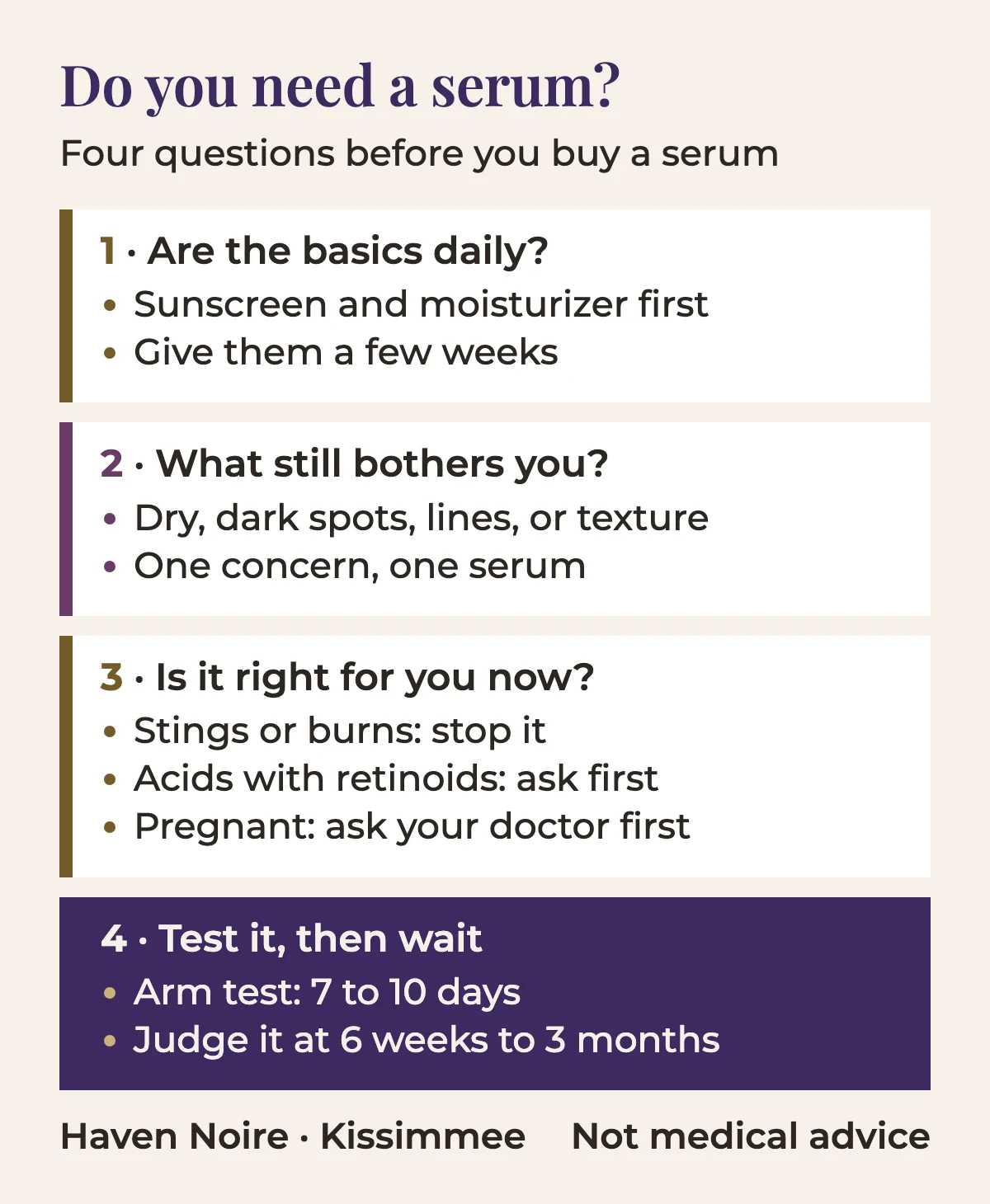
1. Are sunscreen and moisturizer already daily?
Start where dermatologists start. The AAD's guide to choosing anti-aging products says to begin with sunscreen and moisturizer, give them a few weeks, then look at your skin. No daily sunscreen yet? Spend your serum money there. Our guide to sunscreen for dark skin shows what to look for.
2. What's the one thing still bothering you?
Pick one concern: dryness, dark spots, fine lines, or rough texture. The AAD says focusing on one concern gets the best results, partly because using more than one anti-aging product in a few days or weeks can irritate skin. Not sure what your skin is doing? Start with our guide to skin types.
3. Is it right for your skin, your shelf, and your life right now?
Your skin
If a product burns or stings when you apply it, the AAD says to stop using it; if your dermatologist prescribed it, ask before you stop. Skin that already stings needs fewer products, not a new one: our skin barrier guide walks you through a reset first.
Your shelf
Harvard Health warns about stacking acids. Your skin may get irritated if you pair a vitamin C serum, which is acidic, with a retinol cream, or a retinol serum with a prescription retinoid cream. Count what's already in your cleanser, toner, and moisturizer.
Your life right now
Pregnant, trying to conceive, or using isotretinoin, tretinoin, or another prescription skin medicine? Talk to your doctor or dermatologist before adding any serum. The AAD's pregnancy skin care guide lists retinoids, including over-the-counter retinol, among ingredients to avoid while pregnant. Eczema, rosacea, or a lot of redness? Ask your dermatologist first.
4. Test it, then give it six weeks
The AAD's guide to testing skin care products says to try a new product on a quarter-sized spot, such as the underside of your arm, twice a day for seven to 10 days. A separate AAD page of anti-aging tips gives a shorter version, four to five days on your inner forearm; we'd go with the longer one.
Then be patient. The AAD's tips for getting results from anti-aging products say most products take at least six weeks to work, and sometimes up to three months.
| Question | Ask yourself | What the source says | If the answer is no |
|---|---|---|---|
| 1. Daily basics | Sunscreen and moisturizer every day? | AAD: the two most effective anti-aging products | Start there; the serum can wait |
| 2. One concern | Can I name one concern? | AAD: focus on one concern for the best results | Wait until one stands out |
| 3. Right for you | No stinging, no stacked acids, no pregnancy or prescription conflict? | AAD: stop what stings. Harvard: take care stacking acids | Ask your doctor or dermatologist first |
| 4. Time to work | Ready to test for 7 to 10 days, then wait 6 weeks? | AAD: most products take at least six weeks | Don't judge it, or add another, too soon |
How to Apply a Face Serum
- Cleanse gently. Our double cleansing guide covers when one cleanse is enough.
- Use a toner if you like one. It's optional.
- Apply a few drops of serum. Harvard Health says a few drops treat your whole face.
- Follow with moisturizer. A Harvard dermatologist says serums typically go on after cleansing but before moisturizing.
- In the morning, finish with a broad-spectrum, water-resistant sunscreen with SPF 30 or higher, as the AAD recommends.
Morning or night, and how often?
Retinoids belong at night. A dermatologist on the AAD's retinoid page advises using them only at night, with sun protection by day, and starting with the least-intense formula every other night, building up slowly. In the AAD's pregnancy guide, a dermatologist suggests vitamin C in the morning and glycolic acid in the evening to help with skin color changes. Our advice for any new active: start a few nights a week, and add nights only if nothing stings.
Price, Labels, and "Clinically Proven": Reading a Serum Bottle
A serum's price tells you little. Harvard Health puts serum prices anywhere from less than $20 to hundreds of dollars, and quotes Dr. Waldman: "To be honest, I don't think price makes a difference." The AAD agrees that effective anti-aging products come in all price ranges.
What does matter, says Harvard dermatologist Dr. Maryam Asgari, is the active ingredients, the formulation, the vehicle, and the stability of the compound. Four label checks:
- "Clinically proven" means consumers tried the product, the AAD says. It doesn't mean clinical trials or FDA approval.
- The retinol percentage may be missing: an AAD dermatologist notes over-the-counter labels don't have to list it.
- Buy dark-spot products carefully. The AAD says researchers have found unlisted steroids or mercury in some imported products, and advises one made in the United States or recommended by your dermatologist.
- Prone to irritation? The AAD says gentler products are often labeled "for sensitive skin" or "fragrance-free."
Prefer to start with a professional line? See the professional skincare lines we work with, and bring your one job to your visit.
Face Serums on Melanin-Rich Skin: Gentle Beats Strong
On brown and Black skin, a serum's worst side effect may be a dark mark. The AAD's dark-spot guide lists an irritating skin care product among the triggers, and says that once the cause stops, a spot a few shades darker than your skin usually fades within 6 to 12 months. Deeper color can take years.
On its retinoid page, dermatologist Sonia Badreshia-Bansal puts it plainly: "With skin of color, irritation can trigger dark marks." She adds that starting slowly and using moisturizer will help.
Four habits help, all from AAD guidance:
- Stop any product that burns or stings.
- Start retinoids slowly, with moisturizer.
- Wear tinted sunscreen with iron oxide daily: SPF 30 or higher, broad-spectrum, and water-resistant.
- Skip strong chemical or mechanical exfoliation, which can lead to dark spots on darker skin.
Already have marks? Start with how to fade hyperpigmentation on melanin-rich skin. For facials suited to deeper skin tones, read our guide to facials for Black skin.
Where Serums Fit in a Facial at Haven Noire
Our Signature and corrective facials both end with serums. The Signature Facial's last step is serums, moisturizer, and SPF, sealing in hydration and protection. Corrective facials end the same way, plus a home-care plan to maintain progress.
Three corrective options name serums in their menu descriptions:
- Microdermabrasion + Nano Infusion: microdermabrasion polishes away dull, dead skin, then nano infusion applies hydrating serums. Our menu lists it for dull, uneven, textured, aging, or hyperpigmented skin.
- Dermaplane + Nano Infusion: smoothing dermaplaning paired with nano infusion to remove dull skin and peach fuzz, in our menu's words "creating a polished canvas for active serums." Our menu lists it for all skin types.
- Hydrofacial: a gentle, water-based hydrodermabrasion treatment that, in our menu's words, exfoliates while infusing nourishing serums.
Each is a Corrective Facial at $135, or $360 for a 3-pack. Our nano infusion facial guide explains what that step is and isn't. The Corrective Membership is $109.99 a month for one corrective facial of your choice, with a three-month minimum; see memberships.
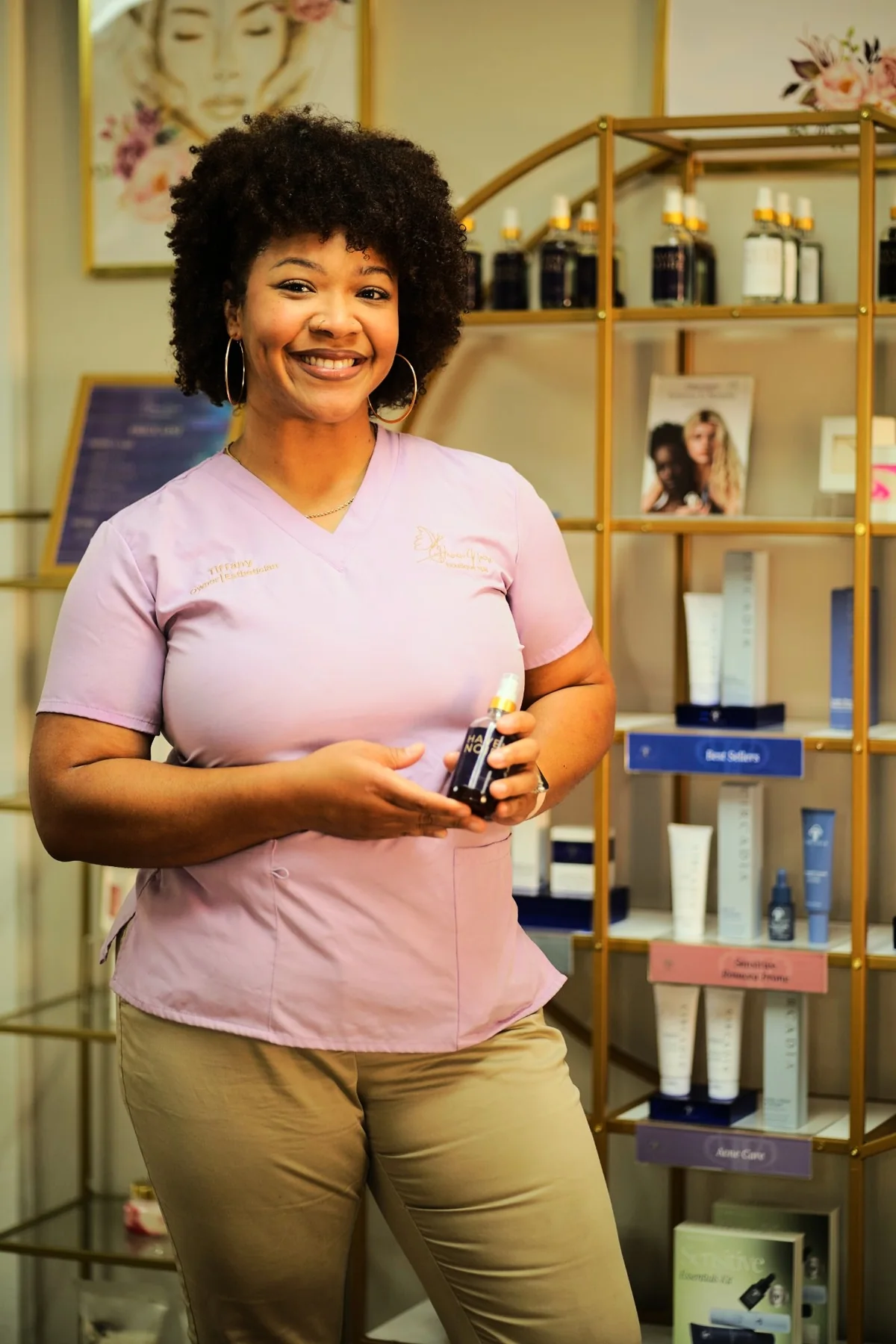
Haven Noire is an esthetics spa, not a medical office. Tiffany, our founder, is a Florida-licensed esthetician, and we work with professional lines from Circadia by Dr. Pugliese, Dermalogica, and Skin Script. Want to know which serums go into your facial? Ask at your visit, especially if you're pregnant or use a retinoid.
When to See a Dermatologist Instead of Buying Another Serum
A serum is cosmetic care. See a board-certified dermatologist, or your doctor where noted, if:
- You've followed the basics and still don't see results. The AAD says creams, gels, and lotions cannot reduce all signs of aging skin.
- Dark spots aren't fading. The AAD says some need a prescription-strength treatment.
- A reaction is severe and doesn't ease with a cool compress or petroleum jelly. The AAD's testing guide says you may need a dermatologist.
- Your skin has a lot of redness or inflammation. An AAD dermatologist says to skip retinoids and ask about rosacea.
- You have moderate or severe acne scarring, or acne tied to your period or other hormonal changes. The AAD's retinoid page says to see a dermatologist before trying a retinoid.
- Dry skin continues despite good care. The AAD says a condition such as atopic dermatitis or psoriasis may be the cause.
- You're pregnant or trying to conceive. Tell your obstetrician and dermatologist about all the medications and prescription skin care you use, as the AAD advises.
- You take isotretinoin, tretinoin, or another prescription skin medicine. Your dermatologist's plan comes first.
Not sure which professional fits your question? Our guide to esthetician vs. dermatologist sorts it out.
Frequently Asked Questions About Face Serums
Do I really need a face serum?
Not always. The American Academy of Dermatology says sunscreen and moisturizer are the two most effective anti-aging products you can buy. A serum is an optional extra that delivers a concentrated dose of an active ingredient. Add one when sunscreen and moisturizer are daily habits and one concern, like dark spots or dryness, still bothers you.
Can a serum replace my moisturizer?
No. Harvard Health says a skin serum is not a moisturizer like a lotion or cream. A serum carries concentrated actives, while moisturizer traps water in your skin, which the AAD says can help soften the look of fine lines. For very dry skin, the AAD says creams and ointments add more moisture than lotions.
Do you put serum on before or after moisturizer?
Before. A Harvard dermatologist quoted by Harvard Health says serums typically go on after cleansing but before moisturizing. In the morning, finish with a broad-spectrum, water-resistant sunscreen with SPF 30 or higher. Retinoid serums belong at night only, an AAD dermatologist advises, because retinoids can make your skin more sensitive to the sun.
Can I use vitamin C and retinol together?
Be careful. Harvard Health says your skin may get irritated if you use a vitamin C serum, which is acidic, along with a retinol cream. The AAD also advises starting with one anti-aging product, since several at once can irritate skin. Our suggestion: add one, wait, and ask a dermatologist before combining them.
How long does it take for a serum to work?
Usually weeks, not days. The American Academy of Dermatology says most anti-aging products take at least six weeks to work, and sometimes up to three months. Dark spots can take longer: the AAD says a mark a few shades darker than your skin usually fades within 6 to 12 months once its cause stops.
What serum is good for dark spots on Black skin?
The AAD lists azelaic acid, glycolic acid, kojic acid, retinoids, and vitamin C for over-the-counter dark-spot products, and says a fading product tends to work better once you protect your skin from the sun, ideally with a tinted sunscreen containing iron oxide. On darker skin, irritation can cause new marks, so stop anything that stings.
Are expensive serums better?
Not necessarily. In Harvard Health's article, a dermatologist says she doesn't think price makes a difference, and the AAD says effective anti-aging products come in all price ranges. What matters is the active ingredient, the formula, and its stability. Read "clinically proven" with care: the AAD says it means consumers tried the product.
Can I use a face serum while pregnant?
Ask your obstetrician and dermatologist first, and show them your labels. The AAD's pregnancy skin care guide lists retinoids, including over-the-counter retinol, and hydroquinone among ingredients to avoid. The American College of Obstetricians and Gynecologists says it's generally recommended to avoid topical retinoids during pregnancy. Tell us you're pregnant before any facial, too.
More from the Journal

About the author
Tiffany · Licensed Esthetician · Licensed PMU Artist
Tiffany is a Florida-licensed esthetician and permanent makeup artist and the founder of Haven Noire. She specializes in customized facials, corrective skincare, and waxing for melanin-rich and all skin types, and is known for a calm, education-first approach that puts first-time clients instantly at ease.
Meet Tiffany →