

Skin flooding is a hydration trend in which you layer several water-based products, usually a mist or toner, a hydrating serum, and a moisturizer, onto damp skin. NBC News Select reported in October 2025 that it was taking over TikTok, and as of November 2026, Google Trends shows US searches for it below their early-2026 peak but still going.
Does it work? Partly. The moves that help are simple ones the American Academy of Dermatology (AAD) already recommends for dry skin: put moisturizer on while your skin is still damp, then seal that water in. The new part, stacking layer after layer, had no studies behind it in our November 2026 PubMed search, and it's the kind of product pile-up dermatologists warn can lead to irritation and clogged pores.
Below: a simpler three-step routine, tweaks for Central Florida air conditioning, who should skip the trend, and when to see a dermatologist instead.
What Is Skin Flooding?
Skin flooding is a layering routine for skin that feels tight or dehydrated. You cleanse, leave your face damp, apply thin hydrating layers from thinnest to thickest, then lock them in with moisturizer. The aim is plumper, more comfortable skin, not treating any condition.
NBC News Select says most people who try it follow four steps: a hydrating face wash, a toner, a serum, and a moisturizer. Some versions finish with a face oil instead of a moisturizer.
| Step | What it usually is | Its job |
|---|---|---|
| 1. Cleanse | A gentle cleanser, face left damp | Leaves water on the skin |
| 2. Mist or toner | A hydrating toner or essence (what toner actually does) | Adds water and often a humectant |
| 3. Serum | Glycerin or hyaluronic acid (what a serum does) | Helps skin hold water |
| 4. Moisturizer | A lotion or cream | Seals the water in |
| 5. Sunscreen | Mornings only | Sun protection |
Strip away the extra layers and you're left with advice dermatologists already give. The AAD's dry skin tips for darker skin tones say to pat your skin with a towel but leave some water on it so it feels damp. Then: "You'll use moisturizer to seal in this water." The trend adds more layers between those two steps. On brown and Black skin, those same two steps are the first fix in our guide to ashy skin.
Does Skin Flooding Work? What the Evidence Supports
We searched PubMed in November 2026 for "skin flooding" in article titles and abstracts and found no study of the routine. So the honest answer comes from the individual steps.
Damp Skin Is the Useful Idea
Timing does the heavy lifting. The AAD's top tips for relieving dry skin say: "Be sure to apply your moisturizer when your skin is still damp after taking a shower or bath."
A Water-Binder Needs a Seal
Glycerin and hyaluronic acid are humectants, and both are on the AAD's list of ingredients to look for in a dry skin moisturizer. A 2025 review in the International Journal of Dermatology, written about dry skin, describes humectants such as glycerin as improving hydration and water-holding capacity, and occlusives such as petrolatum as restoring the barrier. A companion review of clinical studies on dry skin in eczema points to the added benefit of combining the two. As the AAD's tips on anti-aging products put it: "Moisturizer traps water in your skin."
More Layers Add More Risk
Here's where the trend overreaches. The AAD's tips for getting results from anti-aging products warn that using several anti-aging products at the same time can irritate your skin, and advise starting with one. In an October 2024 AAD news release on social media skin care trends, dermatologist Samantha Karlin, discussing the glass skin look, said some people "may run the risk of using too many products," which can lead to clogged pores, irritation, and breakouts.
Our take: four hydrating layers aren't four times the water. When two products do the same job, the second mostly adds cost, pilling, and another chance of a reaction.
Watch the toner step, too. Some toners are exfoliating acids, not hydrators, and the AAD's exfoliation guide says exfoliating can be drying to the skin. If your routine already holds an acid, count every exfoliant in your week first.
Oils Seal, but They Don't Hydrate
In a December 2025 Consumer Reports article, one dermatologist said face oils are there to support the barrier and "reduce water loss, not to hydrate," and dermatologist Dr. Julie Russak said they "work best when applied after a hydrating product, not instead of it." For very dry skin, AAD dermatologist Shani Francis recommends an ointment or thick cream, because butters and oils tend to liquefy on the skin. Thinking of sealing your face under petroleum jelly overnight? Read our guide to slugging first.
Stinging after you add layers? That's a signal to subtract. Our skin barrier guide walks through a four-step reset.
A Simpler Skin Flooding Routine in Three Steps
This routine is built from the AAD's dry skin advice. It keeps the three moves that have support and drops the stacking. The step counts here are our suggestions, not medical rules, and the routine doesn't treat any skin condition.
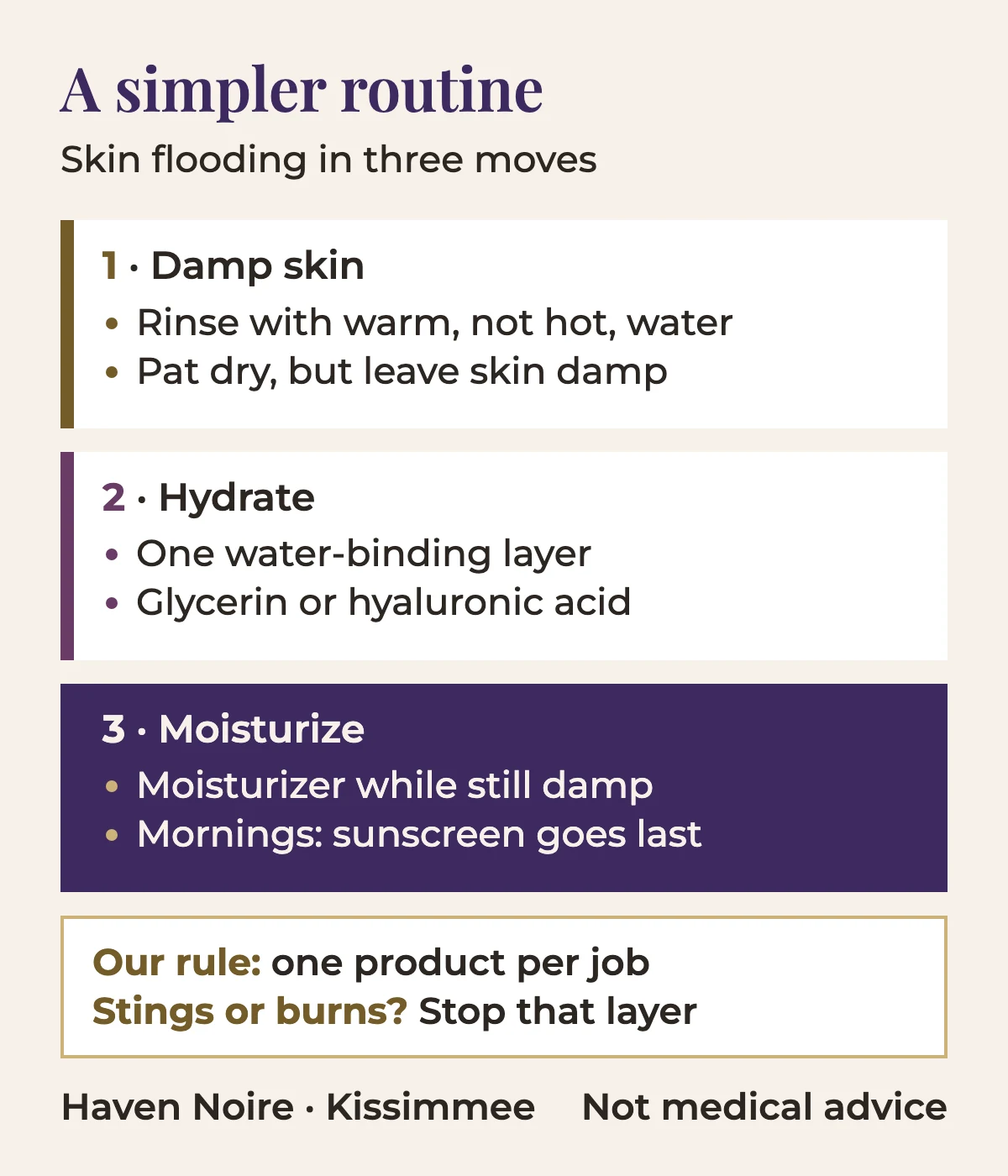
Step 1: Leave Your Skin Damp
Wash with a gentle cleanser and warm, not hot, water; the AAD notes hot water tends to worsen dry skin. Pat your face with a towel, leaving it slightly damp. The AAD says to apply moisturizer immediately after toweling off, so have your next product open.
Step 2: Add One Hydrating Layer
Apply one water-binding layer: a serum, essence, or hydrating toner with glycerin or hyaluronic acid. Our rule: one is enough. Love a mist and a serum? Let them take turns, morning and night.
Step 3: Seal It With Moisturizer
Finish with moisturizer while your skin is still a little damp. The AAD says creams and ointments tend to be more effective than lotions, so go richer where you feel tight and lighter where you shine. Breakout-prone? Choose a moisturizer labeled non-comedogenic. In the morning, add sunscreen last; our guide to sunscreen for dark skin helps you choose.
Your Routine, Morning and Night
Morning
- Cleanse gently and pat until just damp.
- Apply one hydrating serum or toner.
- Seal with a light moisturizer.
- Finish with broad-spectrum sunscreen.
Night
- Cleanse and pat until just damp.
- Apply your hydrating layer.
- Use any prescription or treatment where your dermatologist or its label says it goes.
- Seal with a moisturizer, richer than your morning one if you run dry.
For where every product fits in a full routine, see our morning skincare routine guide.
One Product per Job
| Job | What does it | How many | Cut it if |
|---|---|---|---|
| Damp skin | Water left after rinsing | No product | Your face is dripping wet |
| Hydrate | A serum, essence, or hydrating toner with glycerin or hyaluronic acid | One | Another product already does this job |
| Treat (optional) | One active, such as a prescription your dermatologist chose | One, as directed | It stings; ask first if it's prescribed |
| Moisturize | Moisturizer: cream if dry, lighter if oily | One | It clogs pores or feels greasy for hours |
| Sun protection | Broad-spectrum sunscreen | One, every morning | Never |
Signs you've layered too much: products pill or stay sticky for hours, new clogged pores show up, or anything stings. The AAD says to stop using a product that stings, burns, or tingles.
Layering in Humid, Air-Conditioned Central Florida
Melanie Abeyta, an aesthetic nurse practitioner quoted by NBC News Select, says people in drier climates may get more out of the trend, because "skin tends to lose moisture faster in low-humidity conditions." Kissimmee is humid outdoors, so you might think hydration layering isn't for you.
Not so fast. MedlinePlus, from the U.S. National Library of Medicine, lists dry indoor air from heating or cooling systems among the causes of dry skin. Our view: if you spend your day in air conditioning, your dry climate is your office, your car, and your bedroom. Our guide to dry vs. dehydrated skin explains why skin can feel tight indoors and shiny outdoors on the same day.

Our suggestions for a Central Florida day:
- Morning: keep your hydrating layer and moisturizer light, since a heavy seal can feel greasy in humid heat.
- After sweating: rinse, pat until damp, and re-seal instead of piling on a new layer.
- Night: use a richer seal if your cheeks feel tight.
Who Should Skip Skin Flooding or Keep It Short
Acne-Prone or Oily Skin
Keep it to damp skin, one hydrating layer, and a light moisturizer. NBC News Select advises acne-prone readers to consider hydrators that are non-comedogenic and more lightweight, and Abeyta warns that "excessive layering of heavy or occlusive products can lead to clogged pores and breakouts." The AAD's acne tips for skin of color say a product containing oil, such as cocoa butter or shea butter, can clog your pores when you apply it to your face. Not sure which type you are? Our guide to skin types helps you tell.
Sensitive or Stinging Skin
Abeyta says people with reactive or sensitive skin should introduce layers gradually. Our advice: add one new product at a time, after trying it on your inner forearm, as the AAD suggests. If your face already stings, it needs fewer layers, not more. See how we approach sensitive and redness-prone skin.
Retinoids, Prescriptions, and Pregnancy
Using a retinoid or benzoyl peroxide? Keep exfoliating toners out of your layers. The AAD's exfoliation guide says exfoliating while using them may worsen dry skin or even cause acne breakouts.
Pregnant, or using isotretinoin, tretinoin, or another prescription skin medicine? Check with your doctor or dermatologist before you add serums; the AAD says retinoids should not be used during pregnancy. If you have eczema, rosacea, or very reactive skin, ask your dermatologist which layers your skin can handle.
Hydration Layering on Melanin-Rich Skin
The AAD's darker skin guide says dry skin's flaking and discoloration show more on darker skin tones, and dermatologist Chesahna Kindred, quoted there, suggests a moisturizer with ceramides, "which helps to seal in moisture." That makes the moisturizer step a natural home for ceramides.
The risk sits on the other side. The AAD's guide to fading dark spots says a skin or hair care product that irritates your skin can cause dark spots, and that a spot a few shades darker than your natural color usually fades within 6 to 12 months once the cause stops. Simple math: a layer that stings for a week can leave a mark for months, so add one product at a time.
For the bigger picture, read our guide to facials for Black skin. If a mark has already formed, start with how to fade hyperpigmentation on melanin-rich skin.
Where a Hydrofacial or Signature Facial Fits
A facial doesn't replace what you do at home, and no facial treats a skin condition. Haven Noire is an esthetics spa, not a medical office. What a facial can add is a professional cleanse, hydration chosen for your skin that day, and a trained look at your routine.
The Signature Facial
Our menu lists the Signature Facial's benefits as balancing, hydrating, rejuvenating, and relaxing, for all skin types. It opens with a consultation, double cleanse, and skin analysis, adds exfoliation and extractions as needed and a custom mask with facial massage, and ends the way this routine does: serums, moisturizer, and SPF, sealing in hydration and protection.
It's $95 for 60 minutes or $110 for 90 minutes, which adds a hand and arm massage and an eye treatment. Puffy on waking? Our puffy eyes guide sorts overnight fluid from allergies and structure. Afterward, keep skin hydrated, skip harsh actives and heat for 24 hours, and wear SPF daily.
The Hydrofacial
Our Hydrofacial is one of our corrective facials. Our menu describes it as a gentle, water-based hydrodermabrasion treatment that exfoliates while infusing nourishing serums, and lists it for all skin types, including dull, dehydrated, congested, and uneven skin. Afterward, avoid sun and active exfoliants for a few days, hydrate well, and use SPF daily. Comparing it with the branded machine? Read hydrodermabrasion vs. HydraFacial.
Which One to Book
| If your skin feels | Consider | Price |
|---|---|---|
| Tight and dull, otherwise healthy | Signature Facial, 60 minutes | $95, or 3 for $210 |
| Dry most days, or you want more time | Signature Facial, 90 minutes | $110, or 3 for $285 |
| Dehydrated and also dull, congested, or uneven | Hydrofacial (Corrective Facial) | $135, or 3-pack $360 |
| Stinging, raw, cracked, or flaring | A dermatologist first | See the next section |
Prefer monthly care? Glow ($74.99 a month) includes a 60-minute Signature Facial, and Corrective ($109.99) a corrective facial of your choice, Hydrofacial included; members also get 10% off in-spa products. Compare our memberships, or browse the professional skincare lines we use before you shop for your hydrating layer and moisturizer.
When to See a Dermatologist Instead of Adding Layers
We're estheticians, not doctors. No number of layers treats a skin condition, and some dryness is a sign of one. See a board-certified dermatologist if:
- Two weeks of gentle care brings no improvement. The AAD's darker skin guide says its tips should bring some improvement within two weeks, and that some people with darker skin tones live for years with an undiagnosed condition, believing their skin is just too dry for moisturizer to work.
- Itch keeps you up at night, or cracks get deep and bleed. The AAD describes both in excessively dry skin.
- You see yellow crusts, pus or other fluid, or swelling and discoloration, which the AAD lists as signs of infection.
- Itchy skin with dark brown, purple, or grayish patches, or small, rough bumps. The AAD lists these among eczema signs in darker skin tones.
- Burning or stinging when you apply skin care, a warm feeling most of the time, or dusky brown discoloration. The AAD's rosacea guide for darker skin lists these as reasons to see a dermatologist.
- Breakouts that started after you added layers and don't settle once you cut back. We'd call that a dermatologist question, especially on skin that marks easily.
Not sure who fits your problem? Our guide to estheticians vs. dermatologists sorts it out.
Frequently Asked Questions About Skin Flooding
What is the skin flooding trend?
It's a layering routine that spread on TikTok: you cleanse, leave your face damp, then apply several hydrating products, often a mist or toner, a glycerin or hyaluronic acid serum, and a moisturizer, from thinnest to thickest. NBC News Select described it in October 2025 as layering at least four hydrating products.
How many layers do you really need?
Fewer than social media suggests. Our rule is one product per job: one hydrating layer, one moisturizer, and sunscreen in the morning. The American Academy of Dermatology warns that using several anti-aging products at the same time can irritate your skin, so add any new product one at a time.
Is layering hydrating products good for acne-prone skin?
It can be, if you keep it light. Choose hydrators labeled non-comedogenic, skip heavy occlusives and face oils, and keep the routine short. The American Academy of Dermatology says products containing oil, such as cocoa butter or shea butter, can clog pores on your face. If breakouts start after you add layers, cut back and see a dermatologist.
Can you use face oil to seal in hydration?
You can, but don't count on oil to hydrate. Dermatologists quoted by Consumer Reports in December 2025 said oils mainly reduce water loss and work best after a hydrating product, not instead of one. For very dry skin, an American Academy of Dermatology dermatologist recommends an ointment or thick cream, since butters and oils tend to liquefy.
Is skin flooding the same as slugging?
No. Flooding stacks hydrating layers, usually water-based serums under a moisturizer. Slugging is a separate trend that coats the face in petroleum jelly. They can meet at the end: an AAD dermatologist suggests petroleum jelly on damp, very dry skin or over a lotion or cream. If you break out easily, skip heavy occlusives on your face.
Should you layer hydration in the morning or at night?
Either works. In the morning, keep layers light and finish with broad-spectrum sunscreen. At night, a richer moisturizer can be your seal, which suits cheeks that feel tight after a day in air conditioning. If you use a prescription, your dermatologist decides where it goes. Curious about overnight routines? Read our take on the morning shed.
Can a Hydrofacial help dehydrated skin?
Our menu lists our Hydrofacial for dull, dehydrated, congested, and uneven skin, and describes it as a gentle, water-based hydrodermabrasion treatment that exfoliates while infusing nourishing serums. It isn't a daily routine, and results vary. At Haven Noire in Kissimmee it's a Corrective Facial at $135, or $360 for a 3-pack.
Can you try hydration layering while pregnant?
Ask your doctor or obstetrician before you add new serums, and bring the ingredient lists. The American Academy of Dermatology says retinoids should not be used during pregnancy, and layered routines can hide one in a serum or night cream. The same check applies if you take isotretinoin or use tretinoin or another prescription skin medicine.
More from the Journal

About the author
Tiffany · Licensed Esthetician · Licensed PMU Artist
Tiffany is a Florida-licensed esthetician and permanent makeup artist and the founder of Haven Noire. She specializes in customized facials, corrective skincare, and waxing for melanin-rich and all skin types, and is known for a calm, education-first approach that puts first-time clients instantly at ease.
Meet Tiffany →