
Skincare for tweens has become a trend of its own: kids as young as 8 getting into skincare, often with pricey products hyped by influencers, a wave CNN reported in 2024 under the nickname "Sephora kids," after the beauty chain. As of November 2026, researchers are still studying it: a 2026 paper in PLOS ONE describes children and early adolescents who follow advanced skincare routines and use premium products, and the American Academy of Dermatology tied its October 2025 tween advice to the holiday shopping season.
So here's the short answer. A tween needs three products: a gentle cleanser, a fragrance-free moisturizer, and a broad-spectrum, water-resistant sunscreen with SPF 30 or higher, worn every day. That's the simple routine a board-certified dermatologist recommends for tweens in an American Academy of Dermatology (AAD) news release. Retinol, vitamin C, and exfoliating acids can stay on the store shelf.
Below: why the trend's long routines miss the point, what to keep, swap, or skip on the wish list, what changes for Black and brown tweens, and when a doctor should take over.
What Skincare Does a Tween Actually Need?
A tween's skincare routine is three daily habits: wash with a gentle cleanser, moisturize with a fragrance-free product, and wear broad-spectrum sunscreen. The AAD and the American Academy of Pediatrics (AAP) both build their advice for this age on those three steps.
The AAP goes a step further. On its parent site, HealthyChildren.org, the question of whether tweens and teens need a skin care routine gets this reply: "The short answer: No." The pediatric dermatologist who wrote the page explains that young skin doesn't require adult-targeted products or complex routines, then lays out a simple three-step regimen anyway. In other words, a routine is fine. A regimen built for a 40-year-old isn't.
| Step | AAD | AAP |
|---|---|---|
| Cleanse | Gentle, non-abrasive cleanser; once a day in the evening may be enough for dry or sensitive skin | Gentle, fragrance-free, pH-balanced cleanser, morning and night |
| Moisturize | Fragrance-free moisturizer, used regularly | Lightweight, non-comedogenic moisturizer at night: gel for oily skin, light cream for dry skin |
| Protect | Broad-spectrum, water-resistant sunscreen, SPF 30 or higher, daily | Broad-spectrum SPF 30+ mineral sunscreen every morning, even when it's cloudy |
Where the Two Groups Differ
The table shows two small gaps: how often to wash, and the AAP's preference for a mineral sunscreen (zinc oxide or titanium dioxide), tinted for deeper skin tones.
Our advice, not a medical rule: if your tween's face feels tight after a morning wash, try the evening-only option the AAD describes. Below, "our advice" marks the same kind of judgment call.
What About Toner and Serums?
Neither group puts toner in its tween routine, so we'd treat it as optional at this age; see what toner does. The AAP lists serums with active ingredients to avoid unless they're prescribed (what a serum actually does explains why people use them), and our morning and night skincare routine covers the order of steps.
Skincare for a 10 Year Old vs. a 12 Year Old
Age matters less than what the skin is doing. MedlinePlus says puberty usually happens between ages 8 and 13 for girls and 9 and 14 for boys, and that both may get acne. So one 10-year-old still has calm skin while another is already shiny around the nose.
The AAD explains that as tweens become teens, hormonal changes often raise oil production, which can lead to blackheads and breakouts. Teens may add salicylic acid or benzoyl peroxide; for a tween, the AAD says to consult a board-certified dermatologist first. Our advice: watch the skin, not the birthday.
What the Tween Skincare Trend Gets Backwards
In a 2025 study in Pediatrics, Northwestern University researchers created new TikTok accounts registered as 13-year-olds and reviewed 100 skincare videos made by creators aged 7 to 18. They found:
- The routines used an average of 6 products.
- The average routine cost $168.
- Only about one in four videos (26.2%) included sunscreen.
- The 25 most-viewed videos averaged 11 potentially irritating active ingredients, and up to 21.
The authors concluded that these routines often expose kids to ingredients that carry a risk of irritation, allergic contact dermatitis, and sun sensitivity, and offer "little to no benefit" to the kids they target.
Read those numbers side by side and the trend has the routine upside down. It piles on extras, while about three in four videos left out the one step that appears on both the AAD's and the AAP's lists: sunscreen. Seen posts calling it harmful? Our guide asks is sunscreen bad for you and checks each claim.
Anti-Aging Ingredients Solve Problems Kids Don't Have
The AAD's dermatologist recommends that tweens and teens avoid retinol, vitamin C, and exfoliating acids, which target wrinkles, sun damage, and uneven skin tone, "issues that children don't have." Children's skin, the AAD explains, is thinner, more sensitive, and more prone to irritation than adult skin, and these actives can cause redness, burning, or peeling.
The AAP puts retinoids, alpha-hydroxy acids (AHAs), beta-hydroxy acids (BHAs), and vitamin C in the same group, warning that early use can bring rashes, a compromised skin barrier, and long-term sensitization or allergies.
Fragrance and Too Many Products
Scent is the quieter trap. The AAD says added scents can trigger irritation or allergic reactions, which is why it recommends fragrance-free products. Volume matters too: the AAP warns that using many products at once can irritate the skin and may even worsen acne. A New York dermatologist quoted by CNN said some of her younger patients with allergic reactions come in with redness, burning, itching, scaling, and rashes.
Trends That Aren't Really Skincare
The AAP describes overnight routines with face tape and jaw straps, says there's no evidence jaw straps work, and warns that face tape and jaw straps may interfere with comfortable breathing during sleep. Our guide to the morning shed trend covers that routine in full, and our take on glass skin explains why that look is a glow, not a poreless face.
Tween Skincare: What to Keep, Swap, or Skip
The holidays make this harder. The AAD notes that as retailers kick off holiday sales, a tween's wish list can be daunting to navigate, and its dermatologist's number one tip for parents is to choose age-appropriate products.
So here's a quick way to sort the cart, the shelf, or the gift bag, built on the AAD and AAP guidance above. If your child has a skin condition or a prescription, their doctor's plan comes first.
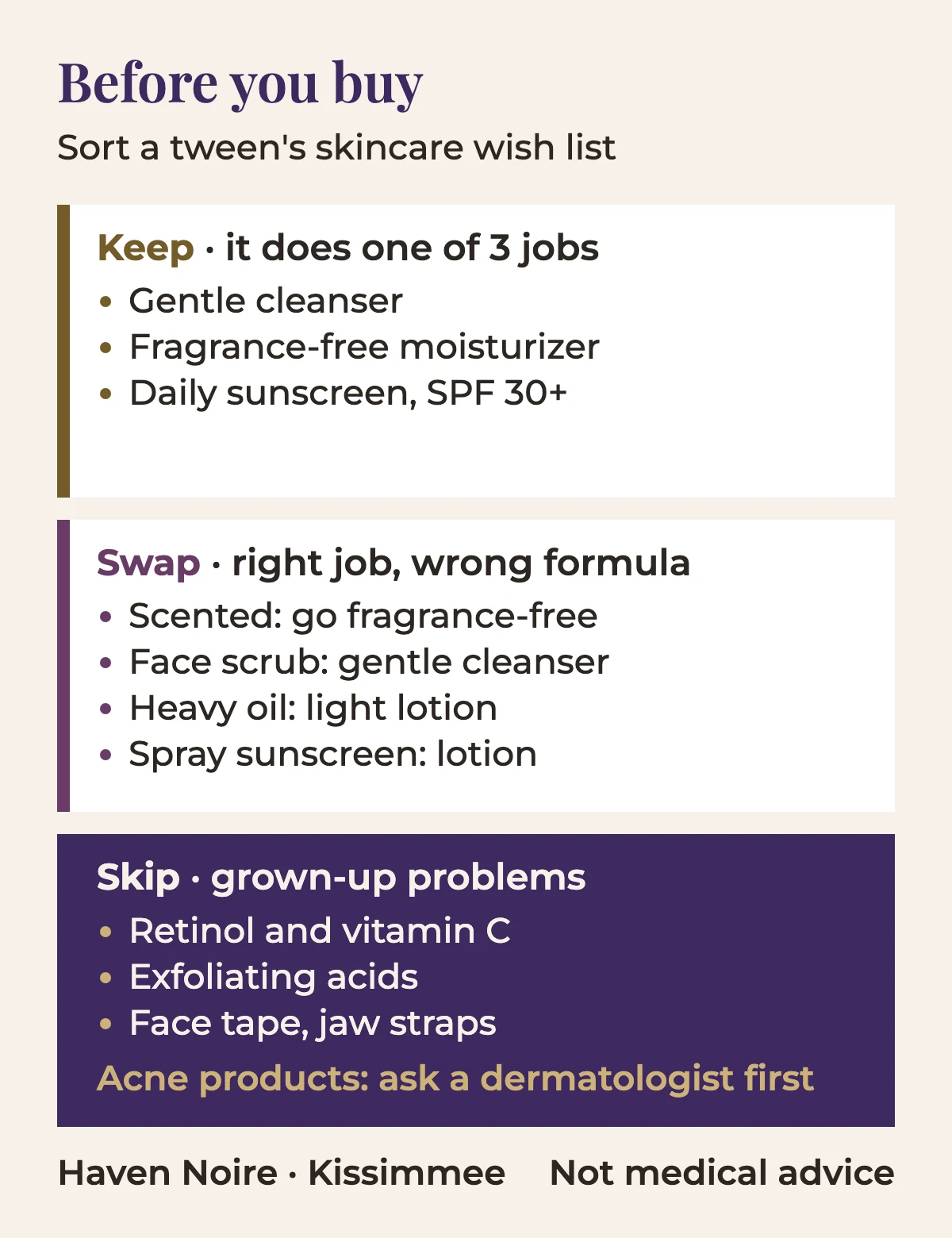
Keep What Does One of the Three Jobs
A product earns a spot if it cleans, moisturizes, or protects, and stays gentle while it does it.
- A gentle, non-abrasive cleanser.
- A fragrance-free moisturizer: a lightweight gel for oily skin or a light cream for dry skin, as the AAP suggests.
- A broad-spectrum, water-resistant sunscreen, SPF 30 or higher. The AAP suggests mineral, tinted for deeper skin tones.
Our advice: put the fun on the outside of the bottle. A cute toiletry bag, a soft headband for face washing, or a mirror for their shelf gives them the unboxing moment without adding a single ingredient.
Swap the Right Job in the Wrong Formula
These products do a job a tween needs, in a version their skin doesn't.
- Scented cleanser or lotion: swap for fragrance-free.
- Face scrub: swap for a gentle, non-abrasive cleanser.
- Heavy oils: swap for a lightweight, non-comedogenic moisturizer, as the AAP suggests.
- Spray sunscreen: swap for a lotion. The AAP lists spray-on formulas to avoid because coverage is uneven.
Skip What Fixes a Grown-Up Problem
- Retinol and vitamin C serums.
- Exfoliating acids (AHAs and BHAs), unless a board-certified dermatologist recommends one for acne.
- Anything sold as anti-aging, firming, lifting, or tightening.
- Face tape and jaw straps. Here's what face tape can and can't do for lines.
The exception is medical: the AAD release notes that a dermatologist may sometimes recommend a retinoid or salicylic acid for a tween, and says to consult a board-certified dermatologist first. That makes it an exam-room conversation, not a store-aisle one.
| On the wish list | What to do | Why |
|---|---|---|
| Gentle, fragrance-free cleanser | Keep | The first of the three basics in both groups' routines |
| Daily broad-spectrum sunscreen, SPF 30+ | Keep | On both medical groups' lists; left out of about three in four trend videos studied |
| Scented lotion for the face | Swap | The AAD says added scents can trigger irritation or allergic reactions |
| Retinol or vitamin C serum | Skip | Targets wrinkles and sun damage children don't have |
| Overnight jaw strap | Skip | No evidence it works; may interfere with comfortable breathing during sleep |
How to Keep the Ritual Without the Irritation
Saying no to the serum doesn't mean saying no to the fun. The same New York dermatologist quoted by CNN said social media feeds a simple feeling at this age: nobody wants to be left out. The 2026 PLOS ONE study, based on interviews with 30 teens aged 13 to 16 in Poland, found parents' involvement ranged from shared beauty practices to restrictive gatekeeping. Our advice: a shared routine usually gives you more say than a flat no.
Here's a five-step plan for the bathroom shelf:
- Sort what's already there into keep, swap, and skip, together and out loud.
- Set aside what you're skipping, and explain why in one sentence.
- Start with the three basics only.
- Add any new product one at a time, as the AAD advises, so you can tell whether their skin tolerates it.
- Stop anything that stings or burns. The AAP calls that a red flag and says irritation isn't a sign a product is working.
Then make the routine theirs. Let them pick the toiletry bag, write the order on a sticky note, and own the two minutes at night. Our guide to skin types is a good next read to share.
What to Say When the Answer Is "Not Yet"
Keep it about skin, not about them. The AAD's dermatologist tells her own children that skincare doesn't have to be complicated, and that something fun or expensive isn't automatically better for skin. More, she adds, is not more. A line that works in the store aisle: "That one's made to fix wrinkles. Your skin doesn't have that problem, so let's find one made for you."
Tween Skincare for Black and Brown Skin
Melanin-rich skin adds one more reason to go gentle. The AAD's guide to clearing acne in darker skin tones says acne in skin of color often comes with dark spots or patches, called hyperpigmentation, which can last much longer than the acne itself. The AAP's advice for deeper skin tones points the same way: skip physical scrubs, limit AHA use, and avoid fragranced products that may worsen hyperpigmentation.
So for a Black or brown tween, irritation can leave a mark that outlasts the pimple. If marks are already there, our guide to fading hyperpigmentation on melanin-rich skin explains how dark marks form and fade, and the AAD lists breakouts that leave dark marks as a reason to see a dermatologist.
Watch the Hairline
Hair care counts as skincare along the forehead. The same AAD page says that if acne appears only on the forehead and temples, hair oil may be the cause, common enough to have a name: pomade acne. It suggests switching to hair products made with water or glycerin instead of oil, and using hair oil only in the middle of the scalp and on the ends of the hair. When you sort the shelf, check the edge and styling products too.
Hands Off the Bumps
First blackheads are tempting to squeeze. The AAD's page on pimple popping lists permanent acne scars, more noticeable acne, more painful acne, and infection among the risks. Its skin-of-color page adds that picking, popping, or squeezing acne raises the risk of a scar. For what to try instead, see our guide to getting rid of blackheads.
Sunscreen in Central Florida
Here, sunscreen isn't a summer-only habit. Both groups say every day, and the AAP adds even when it's cloudy. For deeper skin tones, the AAP suggests tinted mineral sunscreens to prevent a gray or chalky cast, and our guide to sunscreen for dark skin walks through reading the label. Our advice: keep a second bottle in the backpack for recess, practice, or PE.
When to See a Pediatrician or Dermatologist Instead
Haven Noire is an esthetics spa, not a medical office, and some tween skin questions belong with a pediatrician or a board-certified dermatologist. The AAD release advises seeing a board-certified dermatologist when:
- Your child's skin is sensitive or reacting to over-the-counter products.
- Breakouts are leaving dark marks or scars.
- Acne hasn't improved after a few months of over-the-counter treatment.
Add the AAP's red flag: a product that stings or burns. Our advice: stop it right away, and call the pediatrician if the redness or rash doesn't settle.
Some kids need a doctor's plan from day one. If your tween has eczema, uses a prescription acne medicine such as tretinoin or isotretinoin, or has skin that scars easily or forms keloids, their dermatologist should set the routine, not the wish list. The same goes for grown-ups borrowing from the haul: if you're pregnant, ask your doctor before you start retinol or any other active ingredient.
Not sure who handles what? Our guide to estheticians vs. dermatologists sorts it out.
Where Haven Noire Fits for Tweens and Parents
Our advice: most tweens with calm skin don't need a facial yet. Good skincare for tweens happens at the bathroom sink, with the three basics.
For teens, our menu lists teen facials designed for younger skin dealing with hormonal breakouts, excess oil, and sensitivity, a judgment-free space to learn healthy skincare habits. Our online menu doesn't list a minimum age or a teen facial price, so call (321) 900-1144 to ask before you book, or ask us at your own consultation. Our parent's guide to teen facials explains what a visit includes and how to tell when a teen is ready.
Find us at 231 Ruby Avenue, Unit E, across from Lakefront Park, Monday to Saturday from 10 AM to 7 PM.
Frequently Asked Questions About Skincare for Tweens
What skincare should a 10 year old use?
Three products: a gentle cleanser, a fragrance-free moisturizer, and a broad-spectrum, water-resistant sunscreen with SPF 30 or higher every day. That's the American Academy of Dermatology's routine for tweens. If your 10-year-old is already oily or breaking out, the AAD says to consult a board-certified dermatologist before adding acne products. Skip anti-aging serums entirely.
Is retinol safe for an 11 or 12 year old?
Not as an over-the-counter anti-aging product. The AAD says tweens and teens should avoid retinol, vitamin C, and exfoliating acids, which target wrinkles and sun damage children don't have and can cause redness, burning, or peeling. In some cases, a board-certified dermatologist may recommend a retinoid after a consultation.
Do tweens need sunscreen every day?
Yes. Both the AAD and the American Academy of Pediatrics put daily sunscreen in a tween's routine: broad spectrum, SPF 30 or higher, and water resistant in the AAD's version. The AAP suggests a mineral formula, tinted for deeper skin tones, even on cloudy days. In a 2025 Pediatrics study, only about one in four trend videos included it.
What's a good skincare gift for a tween?
Our pick is the three basics in a fun bag: a gentle cleanser, a fragrance-free moisturizer, and a daily SPF 30+ sunscreen, plus a headband or a mirror for the unboxing moment. Skip retinol, vitamin C, exfoliating acids, and anything sold as anti-aging. A Haven Noire gift card, in any amount, can wait for a teen facial later.
Can tweens use salicylic acid for pimples?
Ask first. The AAD says teens with breakouts may benefit from salicylic acid or benzoyl peroxide, and that a dermatologist may sometimes recommend salicylic acid for a tween. Both can dry and irritate the skin, so they pair with a gentle daily moisturizer. For a tween, the AAD says to consult a board-certified dermatologist first, before you buy.
Why is fragrance a problem in kids' skincare?
Fragrance can irritate young skin. The AAD says added scents can trigger irritation or allergic reactions, which is why it recommends fragrance-free products for tweens. The AAP names artificial fragrance among known allergens, and for deeper skin tones it advises avoiding fragranced products that may worsen hyperpigmentation. Look for "fragrance-free" on the label.
Can my tween get a facial at Haven Noire?
Our menu lists teen facials for younger skin dealing with hormonal breakouts, excess oil, and sensitivity. It doesn't list a minimum age or a teen facial price, so call (321) 900-1144 to ask before you book. If your tween's skin is calm, three gentle products at home may be all they need for now.
More from the Journal

About the author
Tiffany · Licensed Esthetician · Licensed PMU Artist
Tiffany is a Florida-licensed esthetician and permanent makeup artist and the founder of Haven Noire. She specializes in customized facials, corrective skincare, and waxing for melanin-rich and all skin types, and is known for a calm, education-first approach that puts first-time clients instantly at ease.
Meet Tiffany →